
New Jersey Motorcycle Accidents
Motorcyclists are 28 times more likely to die in a car accident than vehicle passengers.
Motorcyclists continue to face death and serious injury at higher rates than other road users.
According to a report by the New Jersey Attorney General, "Of all the motorists who share the roads in New Jersey, motorcyclists as a group represent the most vulnerable segment.”
In this report, we examine key trends and statistics in motorcycle crashes. If you’ve been injured in a motorcycle collision, speak to an experienced New Jersey motorcycle accident attorney today to discuss your legal options.
We take great pride in being there for clients when they need us the most. We will do everything in our power to obtain the BEST possible result for you.

Our New Jersey motorcycle accident attorneys have over 35 years of experience fighting for seriously injured clients. We’ve represented our clients in workers’ compensation claims and in personal injury claims.
Motorcycle Accident Trends in New Jersey
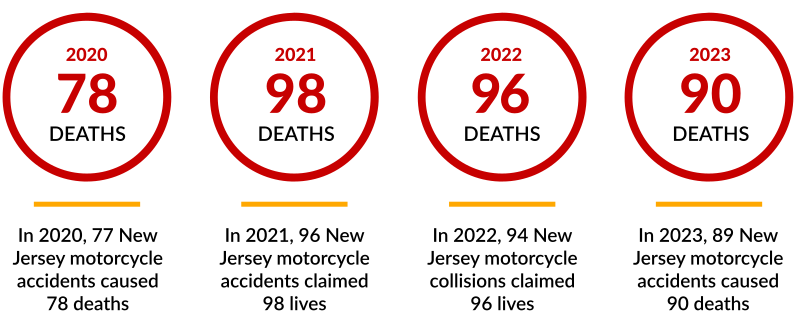
In 2021, 96 motorcycle crashes occurred in New Jersey, claiming 98 lives. Since then, the numbers have declined slightly; 2022 saw 94 collisions and 96 deaths, while 2023 saw 89 collisions and 90 deaths.
However, data since 2014 shows a gradual rise in motorcyclist deaths, from 61 deaths in 2014 to 90 deaths in 2023. The 2021 total of 98 deaths was the highest number recorded since 2006, when 102 people died, according to a news report from NJ101.5.
While it is encouraging to see fatality numbers ticking down, New Jersey still saw a 13 percent increase in motorcycle accident deaths between 2020 and 2023. These numbers indicate there is still work to do to make New Jersey’s roads safe for everyone who uses them.
New Jersey Motorcycle Accidents Fatalities 2022 - 2023
Overview of Motorcycle Accidents in New Jersey and the United States
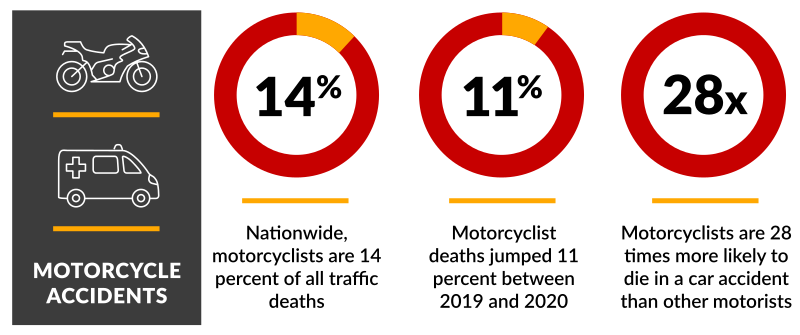
Motorcyclists are 28 times more likely to die in a car accident and five times more likely to suffer serious injuries, according to the NHTSA.
Motorcycle drivers were most likely to suffer death in motorcycle crashes, according to the New Jersey State Police. However, passengers on motorcycles occasionally suffer fatal injuries as well. In 2019, six motorcycle passengers lost their lives in collisions.
According to the National Highway Traffic Safety Administration (NHTSA), in 2020:
- 5,579 motorcyclists died nationwide, representing 14 percent of all traffic deaths - the highest number of deaths since reporting began in 1975.
- Motorcyclist deaths jumped 11 percent between 2019 and 2020.
- 94 percent of those killed in motorcycle crashes were drivers; 6 percent were passengers on a motorcycle.
Trends Seen in New Jersey and Federal Accident Data
New Jersey compiles year-to-date statistics on fatal roadway accidents. As of March 31, 2025, 108 people had died in New Jersey vehicle accidents. Camden and Ocean Counties had the highest death rates, with 12 and 14 fatalities, respectively. These numbers include motorcyclists, vehicle drivers and passengers, bicyclists, and pedestrians.
In 2024, roadway accidents claimed 688 lives in New Jersey. It remains to be seen whether 2025 will exceed this total.
Other common trends in motorcycle crashes in New Jersey and nationwide can also be determined from state and federal data. For example:
- Motorcycle accidents are more common in urban areas (61 percent) than rural ones (39 percent).
- About two-thirds of motorcycle collisions (65 percent) occur at places other than intersections, while about one-third (35 percent) happen at intersections.
- Most motorcycle crashes occur in clear weather (97 percent) and during daylight (57 percent).
- Motorcycle crashes are relatively rare on interstate highways (8 percent) and non-interstate freeways (4 percent). They are far more common on non-interstate main roads like state highways (28 percent).
Of motorcycle accidents happen in urban areas.
Of motorcycle accidents happen at intersections.
Of motorcycle accidents occur in clear weather.
Serious injuries also occur on New Jersey construction sites. According to the BLS, in 2022:
- 3,500 construction workers suffered injuries on the job,
- 2,000 construction workers required time off work to recover from their injuries,
- 300 construction workers required a job transfer or restriction, often with a reduction in pay.
As with deaths, injury trends from year to year are not consistent. For example, 2021 presented a rise in construction injuries. 2022’s numbers decreased from 2021, but are still higher than some previous years. Efforts to reduce the number of serious injuries on New Jersey construction sites have not produced consistent improvements in safety for workers.
Risks to Motorcyclists from Drunk Drivers

Drunk driving claims thousands of lives nationwide each year. In 2022, the NHTSA estimated that 13,524 people died nationwide in a crash caused by a drunk driver. The NHTSA notes that “these deaths were all preventable.”
Common Causes of New Jersey Motorcycle Accidents
The New Jersey State Police track “contributing circumstances” to fatal motorcycle accidents in New Jersey. In 2023, the most common causes of these crashes included speeding, driver inattention, and drunk driving. Other causes included improper passing, improper lane changes, drivers crossing the center line, and drivers following a motorcycle too closely.
Intoxication
Drunk driving claims thousands of lives nationwide each year. In 2022, the NHTSA estimated that 13,524 people died nationwide in a crash caused by a drunk driver. The NHTSA notes that “these deaths were all preventable.”
Drunk or drugged driving greatly increases the risk to others on the road. The effects of drunk driving can greatly impair a driver’s ability to spot motorcyclists or to control their vehicle to prevent a collision with a motorcyclist.
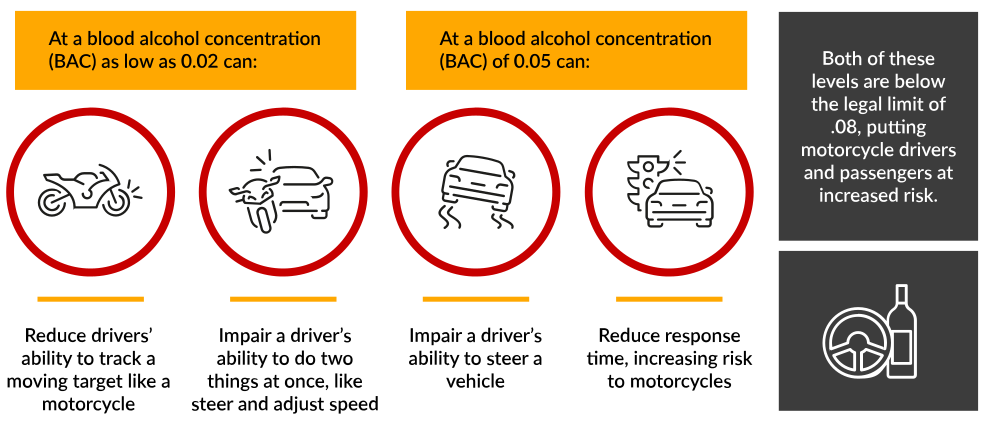
According to the NHTSA, a blood alcohol concentration (BAC) as low as 0.02 percent can reduce a driver’s ability to track a moving target like a motorcycle. This BAC can also impair a driver’s ability to do two things at once, like track a motorcyclist and adjust a vehicle’s speed to avoid a crash.
A BAC of 0.02 percent is significantly lower than the legal limit for driving, and it can be reached by as few as one drink for many people.
At a BAC of 0.05 percent, a driver’s coordination drops. They may have difficulty steering a vehicle - an essential skill when navigating near motorcyclists. Response time to emergency driving situations may be reduced, increasing the likelihood the driver will sideswipe, rear-end, or fail to see a motorcyclist in an intersection.
Common Difficulties of Alcohol Impariment
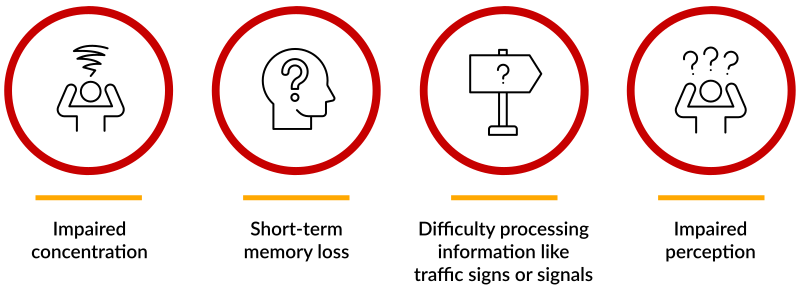
At the legal limit of 0.08 percent BAC, a driver may experience impaired concentration, short-term memory loss, difficulty processing information like traffic signs or signals, or impaired perception. There’s a reason criminal laws prohibit drivers from operating motor vehicles at this level of impairment - it simply becomes too dangerous, both for the driver and for others on the road. Spotting a motorcyclist and maneuvering to avoid them becomes extremely difficult.
At BAC levels above 0.08, drivers may lose the ability to keep the vehicle in its lane or to brake in time to avoid hitting traffic in front of the vehicle. Both of these problems can result in a driver causing a collision with a motorcyclist.
Inattention or Distraction
Driver inattention or distraction was the most common “contributing circumstance” to fatal motorcycle accidents in New Jersey. In 2023, 25 motorcyclist deaths resulted from driver inattention.
Drivers must pay close attention to the road to avoid causing accidents. Drivers who aren’t paying attention to the road are more likely to cause serious injuries. For example, a driver who fails to pay proper attention at an intersection may turn left into the path of an oncoming motorcycle, causing serious injuries or death.
Speeding
The second most common contributing factor to motorcycle crash deaths in 2023 was “unsafe speed,” according to the New Jersey State Police.
Cars traveling at an unsafe speed for conditions are more likely to cause a collision. A speeding driver cannot safely stop in time to avoid crashing into another vehicle, including a motorcycle. Driving at an unsafe speed may occur even if the driver is traveling at or below the posted speed limit. Darkness, weather, heavy traffic, and other factors can cause the “safe speed” for an area to be much lower than the posted speed limit. A driver who drives too fast to handle their vehicle safely is traveling at an “unsafe speed.”
Other Common Causes of Motorcycle Accidents
Common contributing factors to motorcycle crash deaths include:
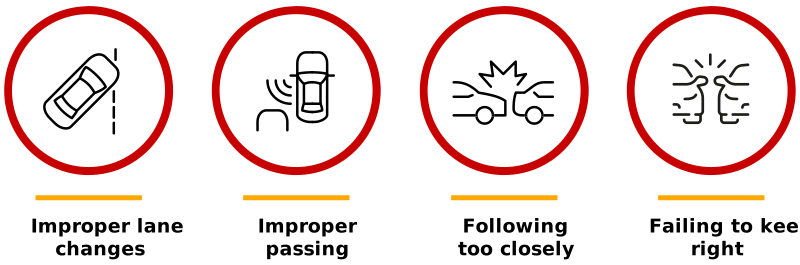
Other Common Causes
Other common contributing factors to motorcycle crash deaths in 2023 included:
- Improper lane changes. Improper lane changes can lead to sideswipe and other crashes. These collisions claimed the lives of three motorcyclists in 2022.
- Improper passing. Passing a motorcycle without using due care can cause serious injuries or death. In 2023, eight motorcyclists died in an accident involving improper passing.
- Following too closely. A driver following a motorcycle too closely may rear-end the motorcycle, causing death or serious injury. In 2022, following too closely contributed to the deaths of five New Jersey motorcyclists.
- Failing to keep right. A driver who crosses the center line of a roadway can cause a deadly head-on collision with a motorcyclist. This situation resulted in six motorcyclists’ deaths in 2022.
Types of Motorcycle Collisions
According to the New Jersey State Police, the most common types of motorcycle collisions between 2019 and 2023 included drivers turning left in front of motorcycles and angle collisions. Other common collision types included rear-end and sideswipe crashes.
Angle
In 2023, 12 fatal motorcycle accidents involved angle crashes - a slight decrease from 2022, in which 17 angle crashes claimed lives.
Angle crashes occur when a driver hits a motorcycle at an angle. They can result from drivers making improper lane changes or turning without looking and hit a motorcycle that has the right of way at an intersection.
Left Turn
Left-turn crashes occur when a vehicle driver turns left or makes a U-turn into the path of an oncoming motorcycle. In 2023, these collisions accounted for 21 motorcyclist deaths in New Jersey.
Left-turn crashes were the second most common cause of motorcyclist deaths in 2023, after fixed-object collisions. They frequently result from a driver failing to yield the right of way to a motorcyclist. In many left-turn collision reports, a driver states that they didn’t see the motorcyclist - often because the driver failed to pay adequate attention to the road before making the turn.
Rear-End
Motorcycles stop more quickly than cars. Their small size also challenges drivers to determine exactly where the motorcycle has stopped in front of the vehicle. If drivers aren’t paying adequate attention or leaving sufficient following distance, they can rear-end a motorcyclist.
In 2023, nine New Jersey motorcyclists died in rear-end collisions. While this number represents a decrease from 2022’s recorded 14 deaths in rear-end crashes, it demonstrates the importance of drivers leaving adequate following distance and paying close attention to motorcycles.
Sideswipe
Collisions involving a car sideswiping a motorcyclist claimed seven motorcyclists’ lives in 2023. Improper lane changes, improper passing, and similar maneuvers can cause a car to hit a motorcyclist side-on. Drivers can prevent these crashes by taking additional care around motorcycles.
Data from this report was gathered from the National Highway Traffic Safety Administration (NHTSA), New Jersey 101.5 news reporting, the New Jersey Department of Health, the New Jersey State Police, the New Jersey State Police Fatal Accident Investigation Unit, the State of New Jersey Department of Law & Public Safety.
Contact An Experienced New Jersey Motorcycle Accident Attorney Today
After a motorcycle accident, you can take steps to protect your legal rights and those of your family. Do your best to follow these steps after a crash. If you cannot complete any of them, reach out to an experienced New Jersey motorcycle injury lawyer for help.
- At the scene, call 911 for emergency assistance. Do your best to move out of the way of traffic, but do not move a seriously injured person.
- Gather information. Police reports, photos or videos of the scene, drawings, and diagrams, or notes of what you remember can all help.
- Get insurance and contact information from everyone involved, if you can. Collecting contact information from witnesses can help as well.
- Get medical attention as soon as possible. This may mean visiting an emergency room, going to urgent care, or scheduling a “next available” appointment with your doctor. Your doctor can document your injuries and prescribe appropriate treatment.
Finally, reach out to an experienced attorney. Your lawyer can help you navigate legal matters after a crash.